What is the best booking app for a tattoo artist?
The best booking app for a UK tattoo artist takes the deposit when the client books, gives a half day or a full day session its real length, lets clients book a free consultation before custom work, gets the consent form and the under-18 question answered before the session and shows your work on the booking page. Covered Beauty, which we make, does all of that from £9 a month if you work alone, or £19.99 for a studio of up to five, with no commission. If you want a marketplace to bring you new clients, Booksy and Fresha are built for that, and Square Appointments has a free plan if you already take cards with Square.
We make Covered Beauty, so we’ve also set out the alternatives and who they suit. Every figure about another provider links to its own page, with the day we checked it.
What does a tattoo booking need?
- The deposit when they book. A full day held for one client is a day you can’t sell twice. Taking the deposit online as they book saves chasing a bank transfer through a string of messages.
- Sessions as long as the work. A small piece, a half day and a full day on a back piece aren’t the same booking. The diary has to hold the whole session, not just its start.
- A consultation before custom work. Custom pieces start with a talk about the idea, the placement and the size, then a quote. That talk should be bookable on its own, and free if you don’t charge for it.
- Big pieces over several sittings. A sleeve or a back piece takes a run of sessions with healing time between them, and each one needs its own place in the diary.
- The consent form and the age question. Health questions, allergies and the client’s date of birth belong on a signed form before the session, not on a scrap of paper on the day.
- Your work where they book. Clients choose an artist by their style. Photos of your work on the booking page let them see it before they pay a deposit.
- Aftercare in writing. Clients forget half of what you said in the chair. An aftercare email a few hours later puts it where they can find it again.
How do you run tattoo bookings on Covered Beauty?
Sessions from a small piece to a full day
Set up each kind of session you sell with its real length and price, from a small piece to a half day or a full day, up to ten hours. Clients only see start times with room for the whole session. Add a gap after each treatment, up to two hours, to clean down and set up again.
Consultations, then the quote
Add a consultation as a treatment of its own at no charge and it shows as Free on your booking page, with no deposit to pay. Once you’ve quoted, book the session in yourself: on Book a client in, open Set the length or price for this booking and type what you agreed. It’s for that booking only, and the treatment keeps its usual length and price. Tick Staff only on a custom session so nobody books it without talking to you first.
Deposits, online or by link
Set a deposit on each treatment, a fixed amount or a percentage, and clients pay it by card when they book online. For a session you book in yourself, tick Ask for the deposit and the client gets a link to pay it by email, or you copy the link into WhatsApp or a text. You can hold the time until it’s paid, 24 hours unless you pick another time.
Clients can also save the card they pay with. If you set a no-show fee they’re told it before they agree, and nothing is charged automatically: you charge it from the appointment.
Sleeves and back pieces over several sittings
Book each sitting as its own appointment, with the healing time you want between them. If a client comes back on a regular gap, open their appointment and make it recurring. Recurring visits run every 1, 2, 3, 4, 6, 8 or 12 weeks, and each visit is created 14 days before it’s due. Paid for the whole piece up front? Put every sitting in the diary first, then record the money on one of them and tick the others under Also paying for to share it across them.
The consent form and the age question
There isn’t a ready-made tattoo form. The closest is the semi-permanent makeup and microblading form, which asks for the client’s date of birth and whether they’re under 18, says you can’t do the work for anyone under 18, and asks about pregnancy, blood thinners, diabetes, epilepsy and keloid scarring, and allergies to pigment, latex or numbing cream. Start from it, change the wording to fit tattooing and link it to your sessions, and it goes out with each booking.
The age question is one the client answers, so check photo ID in person before you start.
Your portfolio on your booking page
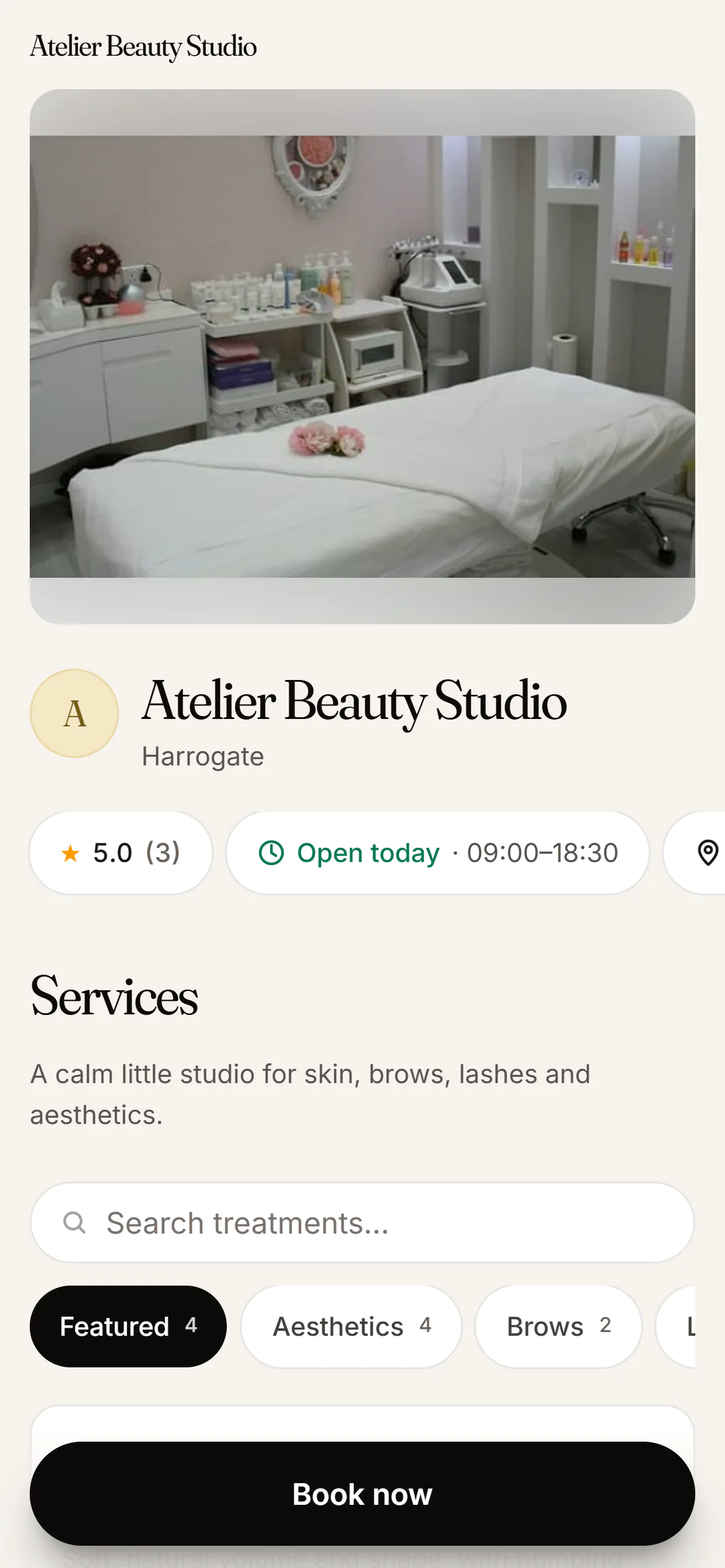
Add up to 12 photos of your work in Settings and they sit at the top of your booking page, where clients swipe through them and tap one to see it full size. You can write your own description for each photo.
Aftercare that goes on its own
Switch on aftercare emails on the Aftercare page, choose how many hours after the session they go and write your aftercare once. A category can send its own notes instead, so piercing clients can get different advice. It only goes once the visit is checked in or marked complete, so a no-show never gets it.
A studio of up to five
On the Team plan, add each artist, up to five, with their own working hours, and clients pick who they book with or take Any available.
What the semi-permanent makeup form asks, the under-18 law and council registration are in What to put in a semi-permanent makeup consultation form.
What comes with every booking
Clients can add up to three more to the same visit and pay one deposit. They get reminder emails three days before, the day before and two hours before, and any form you link to the treatment, with a reminder 48 hours before if it isn’t done. A private form link works for 14 days and only for that client. Worried about people not turning up? Read How to stop no-shows at a UK salon.
What does it cost?
Solo is £9 a month, Pro £14 and the Team plan £19.99 for up to five people. There is no booking commission on any plan, deposits go into your own Stripe account and Stripe’s card fees apply, and consent forms are on every plan. You get 7 days free to try it, with no card needed to start. See the plans.
What are the UK rules for tattooing?
- England. Register yourself and your premises with your local council before you tattoo there. The law is section 15 of the Local Government (Miscellaneous Provisions) Act 1982, where your council has it in force, and GOV.UK’s page on the licence says to contact the council where your premises are.
- London. In Greater London, apart from the City of London, GOV.UK says you need a Special Treatments Licence from your council instead. Tattooing is one of the treatments the London Local Authorities Act 1991 lists.
- Wales. Since 29 November 2024, anyone who tattoos someone as part of a business needs a special procedure licence, unless they’re exempt. Tattooing is one of the four special procedures in the Public Health (Wales) Act 2017.
- Scotland. A business that offers tattooing needs a skin piercing and tattooing licence, under the Civic Government (Scotland) Act 1982 (Licensing of Skin Piercing and Tattooing) Order 2006.
- Northern Ireland. District councils control tattooing under Part V of the Local Government (Miscellaneous Provisions) (Northern Ireland) Order 1985, so ask yours what it needs from you before you start.
- Nobody under 18. The Tattooing of Minors Act 1969 makes it an offence in England, Wales and Scotland to tattoo anyone under 18, except for medical reasons by a doctor or someone working under their direction. It doesn’t extend to Northern Ireland, so ask your council there what age rules apply.
Each link goes to the law or the government’s own page. Your council has the last word on what it needs from you, and Covered Beauty doesn’t check licences or registrations.
When isn’t Covered Beauty the right fit for tattoo artists?
- You only take walk-ins or run flash days first come, first served. There’s no queue screen or walk-in list, so if nobody books ahead, you don’t need it.
- You want clients to send design files or reference pictures with their booking. They can describe the idea, placement and size in the notes box when they book, but there’s no picture upload, so images still come by email or message.
- You want a marketplace to bring you new clients. Booksy and Fresha are built for that. Fresha charges a one-off fee on some new marketplace clients, and Booksy charges only through its optional Boost.
- Beauty in your booking link puts you off. Pages live at yourname.beauty.covered.technology, unless you connect your own web address on Pro or the Team plan.
- You have more than five people, or several branches each with their own staff. The Team plan stops at five people.
- You need drawn signatures or photos inside a form. Forms are signed with a typed name, and the ready-made forms are starting points to check with your insurer.
For every option side by side, read the best salon booking software in the UK.
What are the other options for tattoo artists?
These are the systems most often weighed up for this work, with what each one publishes.
| Option | One person, a month | Commission | Deposits | Consent forms |
|---|---|---|---|---|
| Booksy Source: Booksy UK pricing, checked 1 November 2026 | £40/month plus VAT. Extra users £5/month each | None on standard bookings. Optional Boost: 30% once on a Boost client’s first visit, minimum £5, plus VAT | No-show protection is included. Its card processing fees apply | Custom forms and liability waivers are included |
| Fresha Source: Fresha UK pricing, checked 1 November 2026 | Independent: £14.95/month, excluding VAT. Team: £9.95 per team member a month, excluding VAT | 20% once on a brand-new client from its marketplace, minimum £4, excluding VAT. None on returning clients or your own booking links | Upfront payments and no-show fees through its optional payments. Online card payments 1.40% + 25p | Consultation forms and patch tests are listed among its features |
| Square Appointments Source: Square Appointments UK pricing and Square UK waitlist page, checked 12 October 2026 | Free: £0 for one location. Plus: £29/month per location | None listed | Prepayments on every plan. No-show and cancellation fees need Plus | Contracts sent to clients when they book, on every plan. Custom contract fields on Premium |
Booksy
£40/month plus VAT. Extra users £5/month each. None on standard bookings. Optional Boost: 30% once on a Boost client’s first visit, minimum £5, plus VAT. Best for: salons and barbers who want a consumer booking app as well as a diary. Covered Beauty vs Booksy.
Source: Booksy UK pricing, checked 1 November 2026.
Fresha
Independent: £14.95/month, excluding VAT. Team: £9.95 per team member a month, excluding VAT. 20% once on a brand-new client from its marketplace, minimum £4, excluding VAT. None on returning clients or your own booking links. Best for: salons of any size that want a consumer marketplace to help new clients find them. Covered Beauty vs Fresha.
Source: Fresha UK pricing, checked 1 November 2026.
Square Appointments
Free: £0 for one location. Plus: £29/month per location. None listed. Best for: businesses already taking card payments with Square’s readers or till. Covered Beauty vs Square Appointments.
Source: Square Appointments UK pricing and Square UK waitlist page, checked 12 October 2026.
Which should you choose?
- Clients find you on Instagram and book you for your style? A booking page of your own, with the deposit taken up front and no commission, such as Covered Beauty.
- You want an app where new clients browse artists? Booksy or Fresha, if a client from their marketplace is worth more to you than the fee.
- You already take cards on a Square reader? Try Square Appointments’ Free plan before paying for anything.
- Mostly walk-ins and flash days? You may not need a booking app at all. A price board and a queue at the door can do the job.
Doing cosmetic tattooing, such as brows, lips or eyeliner? Read Booking app for microblading and SPMU artists in the UK.
Questions from tattoo artists
Can I take a deposit before a tattoo?
Yes. Set a deposit on each treatment, a fixed amount or a percentage, and clients pay it by card when they book online. For a session you book in yourself, tick Ask for the deposit and they get a link to pay it, and you can hold the time until they do. The money goes straight into your own Stripe account, with no commission from us. Stripe’s card fee applies.
Can clients book a free consultation first?
Yes. Add a consultation as its own treatment at no charge and it shows as Free on your booking page, with no deposit. After you’ve quoted, book the session in yourself at the length and price you agreed.
Can I book a full day session?
Yes. A treatment can be up to ten hours long, so a half day and a full day are two treatments with their own lengths and prices. Clients only see start times with room for the whole session inside your opening hours.
Does it check the client is over 18?
The semi-permanent makeup form you can start from asks for the client’s date of birth and whether they’re under 18. It’s an answer the client gives, so check photo ID in person before you start.
Can clients send me their design idea?
They can describe it in the notes box when they book, and you see what they wrote on the appointment. There’s no way to add a picture to a booking, so reference images still come by email or message.
What does it cost for a studio of five?
£19.99 a month covers up to five artists, each with their own login and working hours. There’s no charge per artist and no commission on bookings.
What else should you read?
What to put in a semi-permanent makeup consultation form
Medical history, medication, the under-18 rule, council registration and photos: what to ask before microblading, brows and lips.
Read the guideHow to stop no-shows at a UK salon
Every published UK figure and who paid for it, then what deposits, reminders, a card on file and a policy cost you and when each is overkill.
Read the guideHow to get booked from Instagram: a booking link for your bio
Where your booking link goes on Instagram, what its Book now button does, and what makes a follower book without messaging you first.
Read the guide