What should a tattoo consent form include?
A tattoo consent form should take the client’s name, date of birth and address, check they’re 18 or over, and take an emergency contact and their GP. Then it asks about pregnancy or breastfeeding, blood-thinning medication, bleeding or clotting disorders, diabetes, heart conditions, epilepsy, skin conditions where the tattoo is going, keloid or raised scars, allergies including latex and tattoo inks, and alcohol or drugs in the last 24 hours. It records the design, where it’s going and its size, explains the risks and that a tattoo is permanent, and ends with the aftercare, an optional tick for portfolio photos, their consent and a signature with the date. In England, Wales and Scotland it’s an offence to tattoo anyone under 18, so check photo ID in person. Check the final wording with your insurer.
We make Covered Beauty, which has a ready-made tattoo form, so we’ve said where it fits. Nothing here is legal or medical advice. Your council’s conditions, your insurer’s rules and your training come first.
Who can you tattoo?
The Tattooing of Minors Act 1969 makes it an offence to tattoo anyone under 18. The only exception it gives is a tattoo done for medical reasons by a doctor or someone working under their direction. It defines a tattoo as colouring put into the skin that’s designed to leave a permanent mark.
The Act covers England, Wales and Scotland. It doesn’t extend to Northern Ireland, so if you work there, ask your council what age rules apply.
Our form asks for the client’s date of birth and whether they’re under 18, and tells them to bring photo ID. Those are answers the client types, so check photo ID with a date of birth in person before you start, and write in the client’s notes that you did.
What does our tattoo form ask?
Every ready-made form in Covered Beauty starts with the client’s full name, date of birth and home address, so the signed form stands on its own as a record. Then the tattoo form asks:
- Are you under 18? (yes or no)
- Emergency contact (name and relationship) (written answer)
- GP name (so we can follow up if needed) (written answer)
- Do you smoke? (yes or no)
- Are you pregnant or breastfeeding? (yes or no)
- Are you taking blood-thinning medication (including daily aspirin)? (yes or no)
- Do you have haemophilia or another bleeding or clotting disorder? (yes or no)
- Do you have diabetes? (yes or no)
- Do you have a heart condition? (yes or no)
- Do you have epilepsy, or have you ever had a seizure? (yes or no)
- Do you have a skin condition, rash, sunburn or broken skin where the tattoo is going? (yes or no)
- Have you ever had keloid or raised scars? (yes or no)
- Any known allergy, including to latex, tattoo inks or pigments? (yes or no)
- Have you had alcohol or recreational drugs in the last 24 hours? (yes or no)
- Please list any medications, and give details of any yes answer above (written answer)
- The design you’ve agreed with your artist (written answer)
- Where on your body it’s going (written answer)
- Its size, roughly (written answer)
- I’ve had the chance to ask questions, and I understand the risks above and that my tattoo is permanent. (a tick to agree)
- I understand the aftercare advice given and agree to follow it. (a tick to agree)
- I agree to photos of my tattoo being used in the artist’s portfolio and on social media. This is optional, so leave it unticked if you’d rather not. (a tick to agree)
- I confirm the information I’ve given above is accurate, and I consent to this treatment. (a tick to agree)
Along the way it tells the client:
- “We can’t tattoo anyone under 18. In England, Wales and Scotland the law doesn’t allow anyone under 18 to be tattooed, except for medical reasons by a doctor or someone working under their direction. Please bring photo ID with your date of birth on it.”
- “Risks: a tattoo can become infected while it heals, especially if the aftercare isn’t followed. Some people react to the ink, and a tattoo can leave a scar. It’s meant to be permanent, and removing one is hard and doesn’t always work fully. If it gets very red, swollen or sore while it heals, contact us or your GP.”
Its note at the top tells the client that a tattoo puts ink into the skin with a needle and is meant to last for good, that the main risk is an infection while it heals, with a smaller chance of an allergic reaction to the ink or of scarring, and that the questions help you decide whether today is the right day for it.
Because it involves a needle, the form also opens with a stronger note for you: check it against your insurer’s requirements and your professional body’s guidance before you switch it on. Clients never see that note, and it isn’t on the signed form.
It doesn’t ask about numbing cream, so if you use it, add a question asking whether the client is allergic to it. It’s also the consent, not your record of the session: note the inks you used, with their batch numbers and expiry dates, under What was used on the appointment.
Why ask about their health?
The health questions are there so you can decide, before the needle touches the skin, whether to go ahead today, wait, or ask the client to check with their GP first. A yes isn’t always a no. What you do with each answer is for your training, your insurer and the client’s own doctor to guide.
Each one is a plain yes or no the client has to answer before they can send the form. The written question after them asks them to list their medication and give details of any yes, so you have it in their own words, and the emergency contact and GP are there if you need them on the day.
The design, the risks and the aftercare
Three short answers record the design you agreed, where on the body it’s going and roughly how big it is, so the signed form says what the client asked for. Fill them in together at the consultation if the client isn’t sure of the words.
The form then sets out the risks in plain words and asks the client to tick that they’ve had the chance to ask questions and understand the risks and that the tattoo is permanent. A second tick says they understand the aftercare advice you’ve given and will follow it.
Give that advice in writing too. Covered Beauty can email your aftercare as many hours after the session as you choose, and it only goes once the visit is checked in or marked complete, so a no-show never gets it.
Photos for your portfolio
Asking to post photos of a tattoo is a separate question from consent to the tattoo itself. Our form has its own tick for photos in your portfolio and on social media, and it’s never required: a client can leave it blank and still sign the form.
If they tick it, you can add the photo in Settings to the photos of your work at the top of your booking page, up to 12 of them. The form records only their answer, not the photo, so keep your photos where your insurer is happy for you to.
Signatures, dates and keeping the records
Every form in Covered Beauty ends with the client’s typed signature and the date. The blank form has lines for the client’s signature, their name in capitals and yours, with the date.
The health answers are special category data under UK GDPR. The ICO’s guidance, What is special category data?, says data concerning health includes medical history. For a tattoo studio, as for a salon, the condition that usually fits is the client’s explicit consent, which the ICO’s page on the conditions for processing says must be separate from any other consent. Our online forms ask for it with a tick of its own, and the blank form has it printed above the signatures.
UK GDPR doesn’t set a fixed period for keeping forms. The ICO’s guidance on storage limitation says to decide how long you keep each kind of record, write it down and review it, and to consider whether you need records to defend a possible legal claim. Ask your insurer what it expects. Covered Beauty keeps signed forms for 7 years from the appointment, or from the day it was signed for a form filled in without a booking, while your account is open. There’s more in Consent forms and GDPR: a guide for UK beauty salons.
Do you need a licence to tattoo?
Councils register or license tattooists across the UK, and the rules differ in England, London, Wales, Scotland and Northern Ireland. Each is set out, linked to the law, in Booking app for tattoo artists in the UK.
How do you get it signed before they arrive?
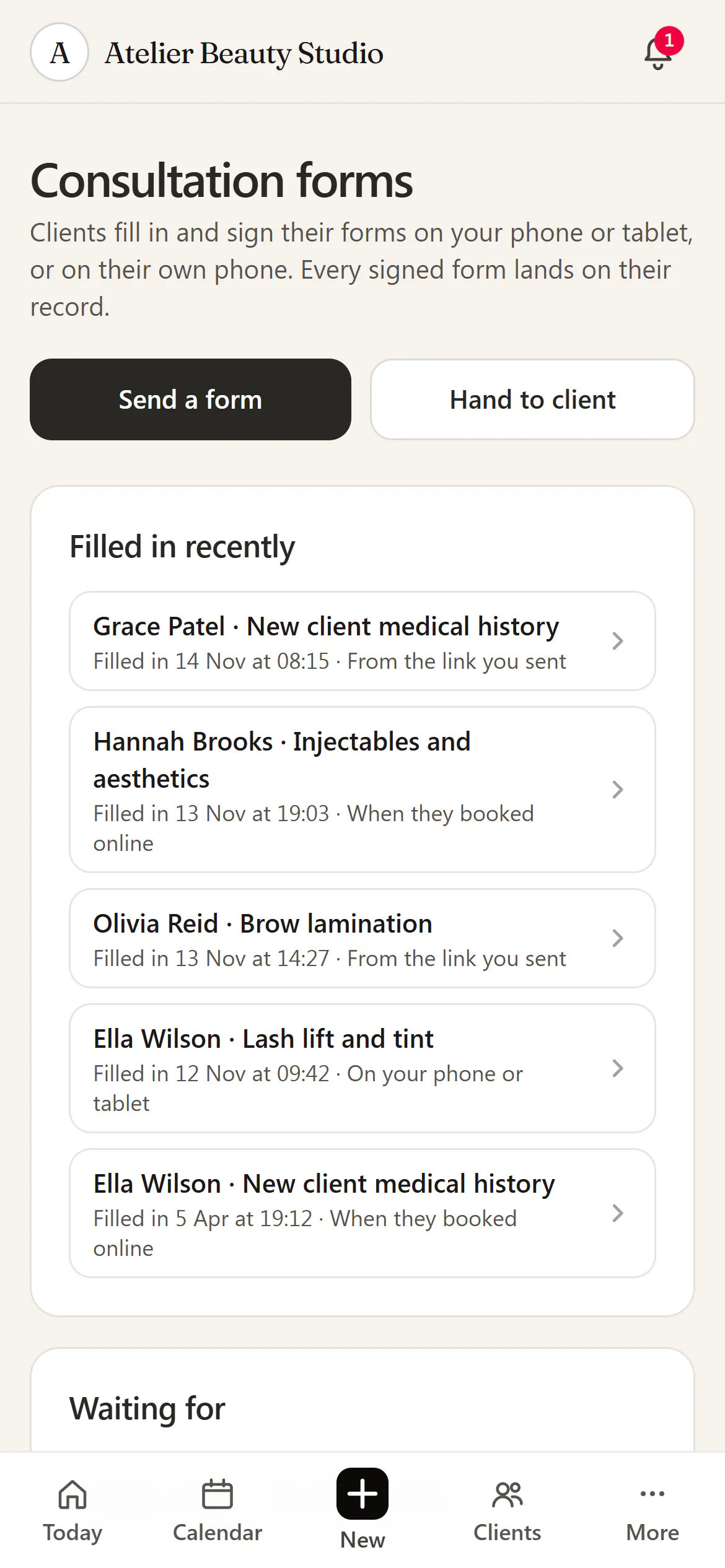
A long session is no time to start with a clipboard. Covered Beauty gives you three ways to have the form done first:
- With their booking. Link the form to your tattoo sessions and it goes out with the confirmation, with a reminder 48 hours before if it isn’t done.
- A private link. Email it, or copy it into WhatsApp or a text. It works for 14 days and only for that client.
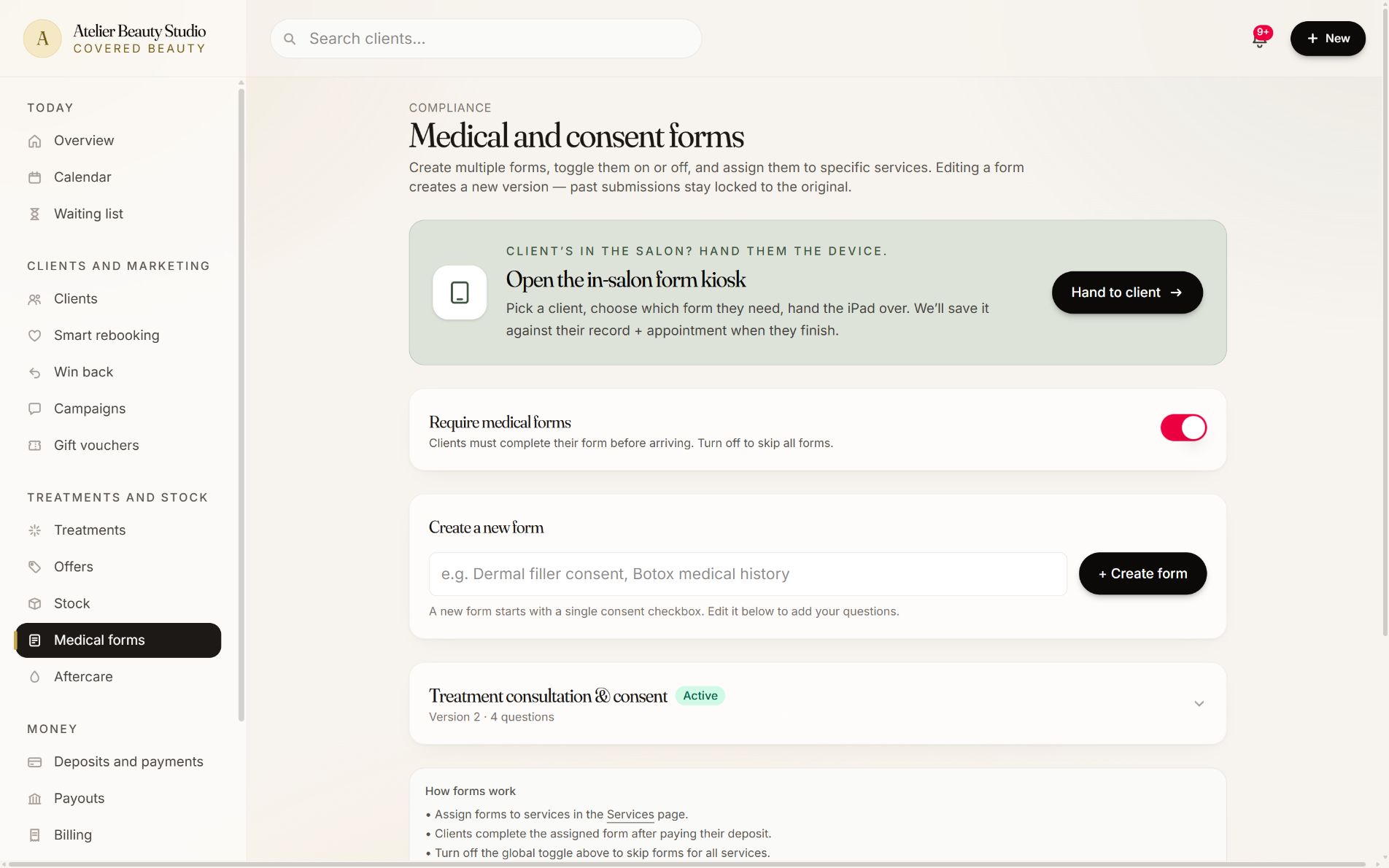
- On your phone or tablet. Set a kiosk PIN, then use Hand to client. It shows only their forms until someone from your team enters the PIN.
The signed form lands on the client’s record, ready to print or download as a PDF. See how online consultation forms work. Try the tattoo form free for a week, with no card needed. Forms are on every plan, from £9 a month.
Download the free blank form
It’s an A4 PDF with every question our form asks (listed above), boxes to tick yes or no, a line for your business name, and lines for the client’s signature and yours with the date. The extra questions we suggest aren’t on it, so write in the ones you need. The foot of each page says it’s a free template from Covered Beauty. Print it, keep a few on a clipboard, and check the wording with your insurer first.
Paper still means the client fills it in once they’re in the chair. Send this form before they arrive, free for a week, with no card needed.
Questions about tattoo consent forms
Can you tattoo someone under 18 if a parent agrees?
Not in England, Wales or Scotland. The Tattooing of Minors Act 1969 makes it an offence to tattoo anyone under 18, and the only exception it gives is a tattoo done for medical reasons by a doctor or someone working under their direction. The Act doesn’t extend to Northern Ireland, so ask your council there what age rules apply.
Do I need to check ID before a tattoo?
Check photo ID with a date of birth in person before you start, such as a passport or driving licence. Our form asks for the client’s date of birth and whether they’re under 18, but those are answers the client types, not a check.
What medical questions go on a tattoo consent form?
Ours asks about pregnancy or breastfeeding, blood-thinning medication, bleeding or clotting disorders, diabetes, heart conditions, epilepsy, skin conditions where the tattoo is going, keloid or raised scars, allergies including latex and tattoo inks, and alcohol or drugs in the last 24 hours, then asks the client to list their medication. Smoking, an emergency contact and their GP are on it too.
How long should I keep tattoo consent forms?
UK GDPR doesn’t set a fixed period. The ICO says to decide how long you keep each kind of record, write it down and review it, and to consider whether you need records to defend a possible legal claim. Ask your insurer what it expects. Covered Beauty keeps signed forms for 7 years from the appointment, or from the day it was signed for a form filled in without a booking, while your account is open.
Is there a free tattoo consent form template?
Yes. The blank tattoo form on this page is free to download and print, with no sign-up. You can also try the same form in Covered Beauty free for a week, edit every word and send it before the session.
Sources
The Act was read on 24 October 2026, and the ICO’s pages on 21 October 2026. Our own form questions are printed as Covered Beauty’s ready-made form asks them today.
Other consultation form guides
Every free blank form, sorted by treatment, is on free salon consultation form templates. Or read what to put in a consultation form for:
What else should you read?
Booking app for tattoo artists in the UK
Deposits taken when clients book, sessions up to a full day, free consultations, the consent form and age question first, and the rules in each UK nation.
Read the guideWhat to put in a semi-permanent makeup consultation form
Medical history, medication, the under-18 rule, council registration and photos: what to ask before microblading, brows and lips.
Read the guideConsent forms and GDPR: a guide for UK beauty salons
What counts as health data, the consent you need, how long to keep forms and what to do when a client asks you to delete them.
Read the guideOnline consultation forms
Send a private link or hand over your tablet, with or without a booking. Signed forms land on the client’s record.
See how it works